
Categories
GaN Charger vs Traditional Charger: Why Gallium Nitride Matters for Your iPhone, MacBook & Android Devices
Time: 2026-05-19 18:43:13
Author: Shenzhen livetechpower technology limited
Click:
Clear, jargon-free comparison for everyday users — covering thermal performance, size advantages, universal device compatibility (iPhone 15/16, Samsung S24, MacBook Air M3), and why GaN chargers deliver safer, faster, future-proof charging in 2026.
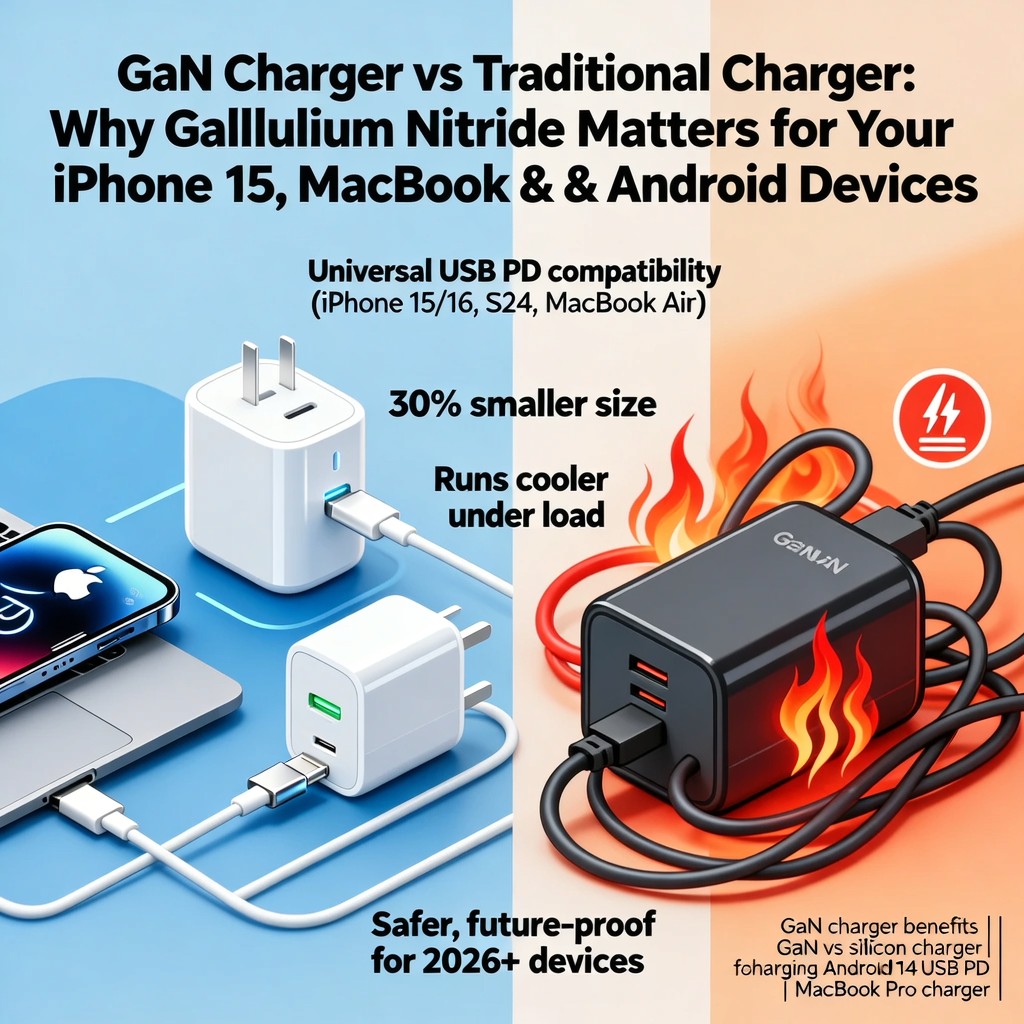
What Is a GaN Charger — And Why It’s Not Just Another Gadget Trend
Gallium Nitride (GaN) is a semiconductor material that has rapidly replaced traditional silicon in modern power adapters. Unlike silicon-based chargers — which have dominated the market for decades — GaN operates at higher frequencies, voltages, and temperatures with significantly less energy loss. This isn’t theoretical engineering: it translates directly into real-world advantages for users of iPhones, MacBooks, and Android devices in 2026.
Thermal Performance: Cooler Charging, Longer Lifespan
Heat remains one of the biggest enemies of lithium-ion batteries and power electronics. Silicon chargers generate substantial waste heat during high-wattage operation — especially when delivering 65W or more to a MacBook Pro or iPhone 15/16 under fast-charging conditions. GaN chargers, by contrast, run up to 30% cooler under identical loads due to lower on-resistance and faster switching. This thermal efficiency reduces internal stress on both the charger and your device, supporting battery longevity and safer sustained charging — particularly important during overnight or desk-bound use.
Size & Portability: Power Without the Bulk
A 100W silicon-based MacBook Pro charger typically weighs over 400 g and occupies significant desk or travel space. A comparable GaN charger weighs under 200 g and fits comfortably in a slim laptop sleeve or even a large jacket pocket. This compactness stems from GaN’s ability to shrink magnetic components (like transformers and inductors) without sacrificing output stability or safety. For professionals carrying an iPhone 15 Pro, Samsung Galaxy S24 Ultra, and MacBook Air M3, swapping a brick-like adapter for a palm-sized GaN unit meaningfully improves daily carry convenience — without compromising performance.
Universal Compatibility: One Charger for Your Entire Ecosystem
Modern GaN chargers are built around USB Power Delivery (USB PD) 3.1 specifications — fully compliant with Apple’s iPhone 15 fast charging requirements (up to 27W), Android 14–optimized PD profiles (including PPS for Samsung S24), and the full 67W–100W range needed by MacBook Air M3 and MacBook Pro models. Crucially, many GaN models feature dual or triple USB-C ports with intelligent power distribution — enabling simultaneous fast charging of an iPhone, iPad, and MacBook without negotiation conflicts or speed throttling. That level of interoperability simply isn’t achievable with legacy silicon chargers lacking dynamic load balancing and adaptive voltage negotiation.
Safety & Future-Proofing: Designed for Today’s Demands — and Tomorrow’s
GaN chargers integrate multiple hardware-level protections — including over-voltage, over-current, over-temperature, and short-circuit safeguards — often exceeding regulatory requirements set by UL, CE, and IEC 62368-1. Their inherent efficiency also reduces fire risk associated with prolonged high-load operation. Looking ahead, GaN technology is foundational to emerging standards like USB PD 3.1 Extended Power Range (EPR), which enables up to 240W delivery — essential for next-gen laptops and AI-powered peripherals expected in late 2026 and beyond. Choosing a GaN charger today means investing in infrastructure that remains relevant through multiple device upgrades.
The Bottom Line: GaN Charger Benefits Are Real, Measurable, and User-Centric
When comparing a GaN vs silicon charger, the differences go far beyond marketing claims. GaN delivers tangible improvements in thermal management, physical footprint, cross-platform compatibility, and long-term reliability — all while meeting strict safety benchmarks required for premium devices like the iPhone 15/16, Samsung S24, and MacBook Air M3. As USB PD adoption continues expanding across iOS, Android 14 ecosystems, and macOS, GaN isn’t just an upgrade: it’s the new baseline standard for intelligent, efficient, and future-ready charging.
创作声明:内容由AI基于参考资料创作生成,请仔细甄别。

点击右上角
分享给朋友吧







 Long by picture save/share

Products
——
Contact Us
——

BLD 1, F1, Zone B, New Baoji Industrial Park, Tiezi Road, Gongle Community, Xixiang district, Bao'an District, Shenzhen City

+86 13631583781

sales1@livetechpower.com

+86 13631583781


Copyright © Shenzhen Livetech Power Co., Ltd
点击右上角
分享给朋友吧
Copyright © Shenzhen Livetech Power Co., Ltd


